Escrow — How It Works
Escrow is the main tool for reducing counterparty risk in forum trades. Some long-standing members offer escrow services: they hold the funds while a trade completes and decide where the money goes if the two sides disagree. There is no official escrow institution, no licensing, and no bond — an escrow agent is a person whose reputation is the only guarantee, so choosing one is itself a judgement call.
The mechanics
- Buyer + seller agree on terms (price, deliverable, deadline)
- Both parties agree on an escrow agent
- Buyer sends BTC to the escrow agent's address
- Escrow confirms receipt publicly in the trade thread
- Seller delivers (ships goods, completes service, transfers altcoins)
- Buyer confirms receipt + instructs escrow to release
- Escrow releases funds to seller, minus the fee the agent stated in advance
- Both parties leave trust feedback
If a dispute arises at step 6, the escrow agent reviews the evidence and decides — within the conditions both parties wrote down, and no further.
What escrow does and does not do
Escrow reduces the risk of non-delivery. It does not protect against disappointment: if the item arrives and is not what you hoped, that is a quality dispute rather than a delivery failure, and that misunderstanding sits behind most escrow complaints. Escrow does not establish who the counterparty is, insure the trade, or create any right of appeal.
Escrow is most useful when one party must perform first, the amount would materially hurt to lose, the counterparty has little verifiable history, or the work cannot be split into stages. It is least useful when the fee is a large share of the trade, both parties can perform simultaneously, or the real risk is item quality rather than non-delivery.
Choosing an agent, and verifying who you are talking to
Signals worth weighing:
- Years of completed escrow trades visible in trust feedback
- Public escrow thread in Services with terms and recent trades
- Fee set by the agent and stated in their thread — read it before agreeing
- Willingness to work from written conditions rather than a verbal understanding
None of these is a vetting mechanism, and neither is being widely known. Impersonation works precisely by borrowing a familiar name, so the reputation you check has to belong to the account you are actually talking to.
Verify the numeric user ID, not the display name. Every profile has a numeric ID in its URL (action=profile;u=NNNNN). Two accounts can display near-identical names, but the number cannot be duplicated. Record the number from a link you navigated to yourself, and check it again before sending anything.
Custody models
- Single key — the agent holds the funds outright. Simple to arrange, and the money depends entirely on that one person.
- 2-of-3 multisig — buyer, seller and agent each hold one key, and any two of the three can move the funds. If the buyer and seller agree, they can complete or refund the trade between themselves without the escrow agent taking part at all. The agent's key matters only when the two sides disagree.
Multisig is not automatically the better choice. It takes more setup, wallet compatibility across three parties is not guaranteed, and each party has to back up and be able to recover their own key. A multisig that nobody can reconstruct is worse than a single key held by someone reliable.
Disputes
When a dispute happens:
- Both parties post evidence in the trade thread
- The escrow agent reviews it against the written conditions
- Funds are released or refunded
The agent's authority extends only as far as the conditions both parties agreed in writing. This is not legally binding arbitration, and there is no forum appeal process — it works because both sides agreed to it and because the agent's reputation depends on it. Write the release conditions down before funding, in the public thread, in language a third party could apply without asking either side what they meant.
When escrow itself fails
Two failure modes are common enough to plan for: the agent goes silent while holding funds, or releases against the written condition.
If a provider becomes unresponsive or acts outside the agreed conditions, preserve the complete written agreement and transaction records first. Raise it with the other party, then in the original public thread. Trust feedback and, where the evidence supports it, the Reputation or Scam Accusations boards exist for documented disputes. Reporting a post to the moderators is a separate route reserved for forum-rule violations such as spam or phishing — moderators enforce rules, they do not judge trades.
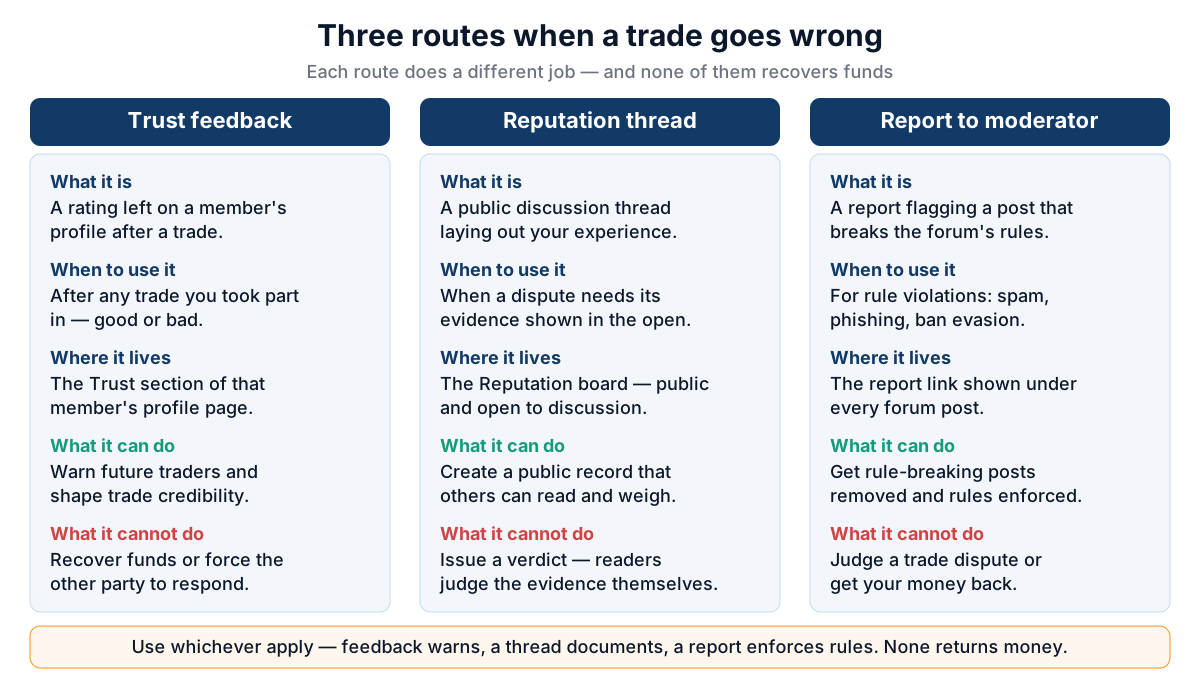
Trust feedback, Reputation threads, and moderator reports each do a different job — warn traders, document a dispute, enforce forum rules — and none of them recovers funds.
Academy original
Acting as an escrow agent
Holding escrow for other people is a long game:
- Understand that this means holding strangers' money, with your reputation as the only bond — it is not a rank reward, and no forum status qualifies anyone for it
- Have a multi-year clean trust history
- Open a thread stating your conditions and fee; start with very small trades
- Build reputation case-by-case over years
The market is small and personal.