Bitcoin Economics
Bitcoin's economic design is what makes it different from every previous money. Three properties define it: hard supply cap, predictable issuance schedule, and a market-determined fee market that eventually replaces issuance entirely.
The 21 million cap
Total issuance under the subsidy schedule comes to slightly under 21 million BTC, and the last non-zero subsidy is paid around the year 2140. That is the theoretical total. Coins whose keys are lost, or which were sent to outputs nobody can spend, are counted in it but will never move again — issued supply and circulating supply are not the same number.
No document gives the cap its authority. There is no charter, no foundation policy and no vote behind it. It holds because every node runs the consensus rules that produce it: a block paying its miner more than the schedule allows is rejected by every other node on the network, miners included. A limit enforced by the software each participant chooses to run is the only kind that doesn't depend on someone keeping a promise.
The halving schedule
Block subsidy halves every 210,000 blocks:
| Year | Block Reward | Total Supply at Halving |
|---|---|---|
| 2009 | 50 BTC | 0 |
| 2012 | 25 BTC | 10,500,000 |
| 2016 | 12.5 BTC | 15,750,000 |
| 2020 | 6.25 BTC | 18,375,000 |
| 2024 | 3.125 BTC | 19,687,500 |
| 2028 | 1.5625 BTC | 20,343,750 |
| 2032 | 0.78125 BTC | 20,671,875 |
By around 2140, the subsidy reaches zero. From that point on, miners are paid only from transaction fees.
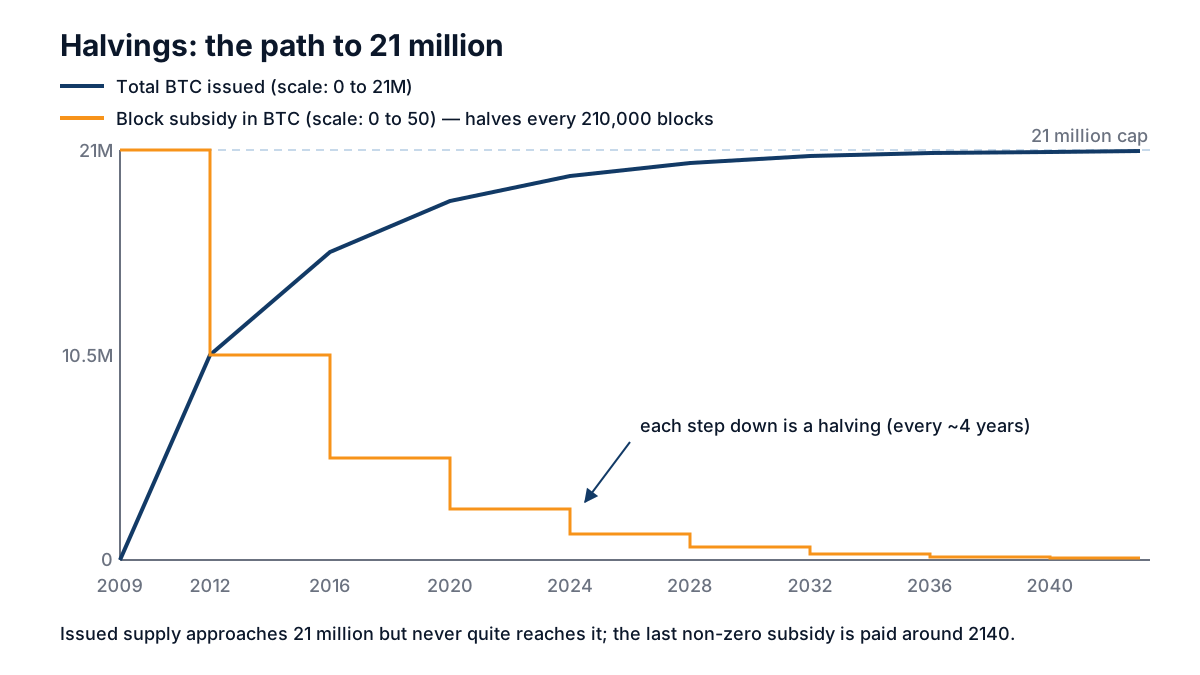
Halvings cut the subsidy in half every 210,000 blocks, so issued supply flattens toward — but never quite reaches — 21 million.
Academy original
The fee market
A transaction's fee is its virtual size in vbytes multiplied by the fee rate the sender picks, in satoshis per vbyte. It is not a percentage of the amount sent. Fees are bid into a market where miners pick the most profitable transactions to include in each block.
Nobody is paid the fee directly. It is simply the difference between a transaction's total inputs and its total outputs, and the miner of the block may claim it through that block's coinbase transaction along with the subsidy. The base protocol does not burn it.
Fee rates rise and fall with mempool demand. When more transactions are competing for the next block than will fit in it, the rate needed to confirm quickly goes up; when demand is light, it falls.
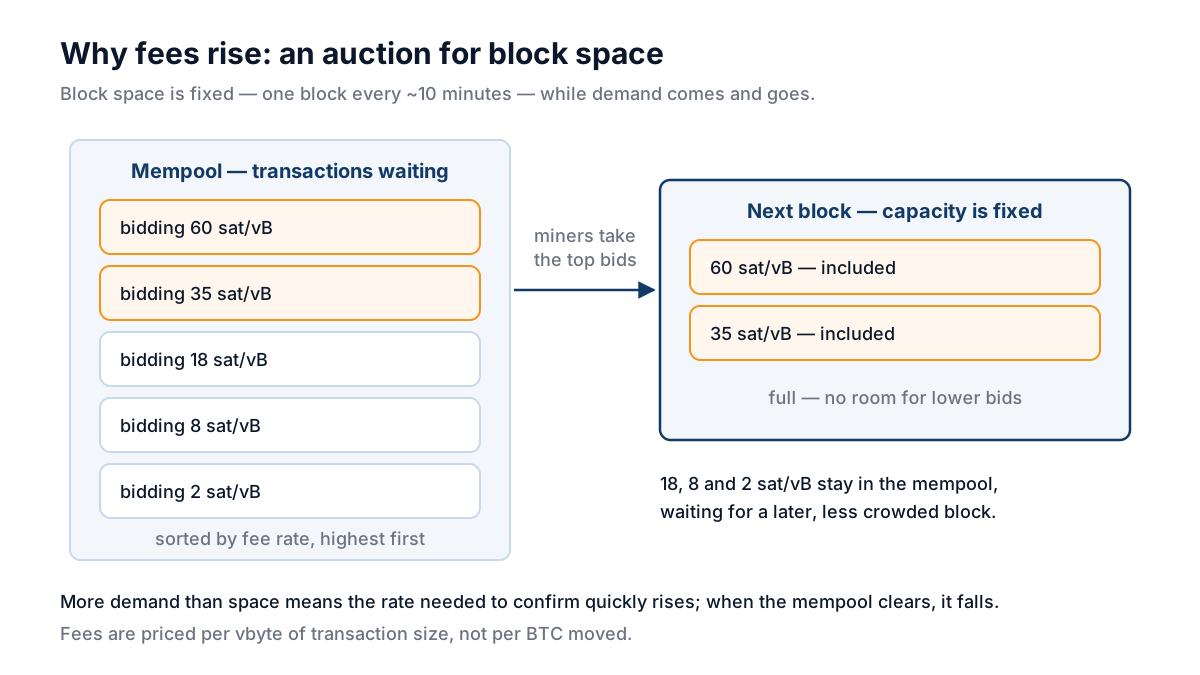
Block space is a fixed-supply auction: when more transactions compete than fit in the next block, the fee rate needed to confirm quickly rises.
Academy original
The security budget question
As the subsidy shrinks, the security budget (miner revenue per block) increasingly depends on fee revenue. Two camps:
- Optimists: As Bitcoin gains adoption, transaction demand will grow enough that fees alone fund robust security.
- Pessimists: Without sufficient on-chain activity, security may weaken in future halving epochs.
This is an open empirical question. The next ~30 years of fee revenue will answer it.
What you actually need to know
- Supply is hard-capped at ~21M
- New issuance halves every ~4 years
- Fees are market-determined per transaction
- Long-term security depends on a healthy fee market
- None of this can be changed by any single party
Those five are fixed by the protocol. Everything else — adoption, narrative, market price — is not, and this course does not forecast any of it.